Why Kids Write More (and Quit Less) with Illustrations: What We Keep Seeing in Practice
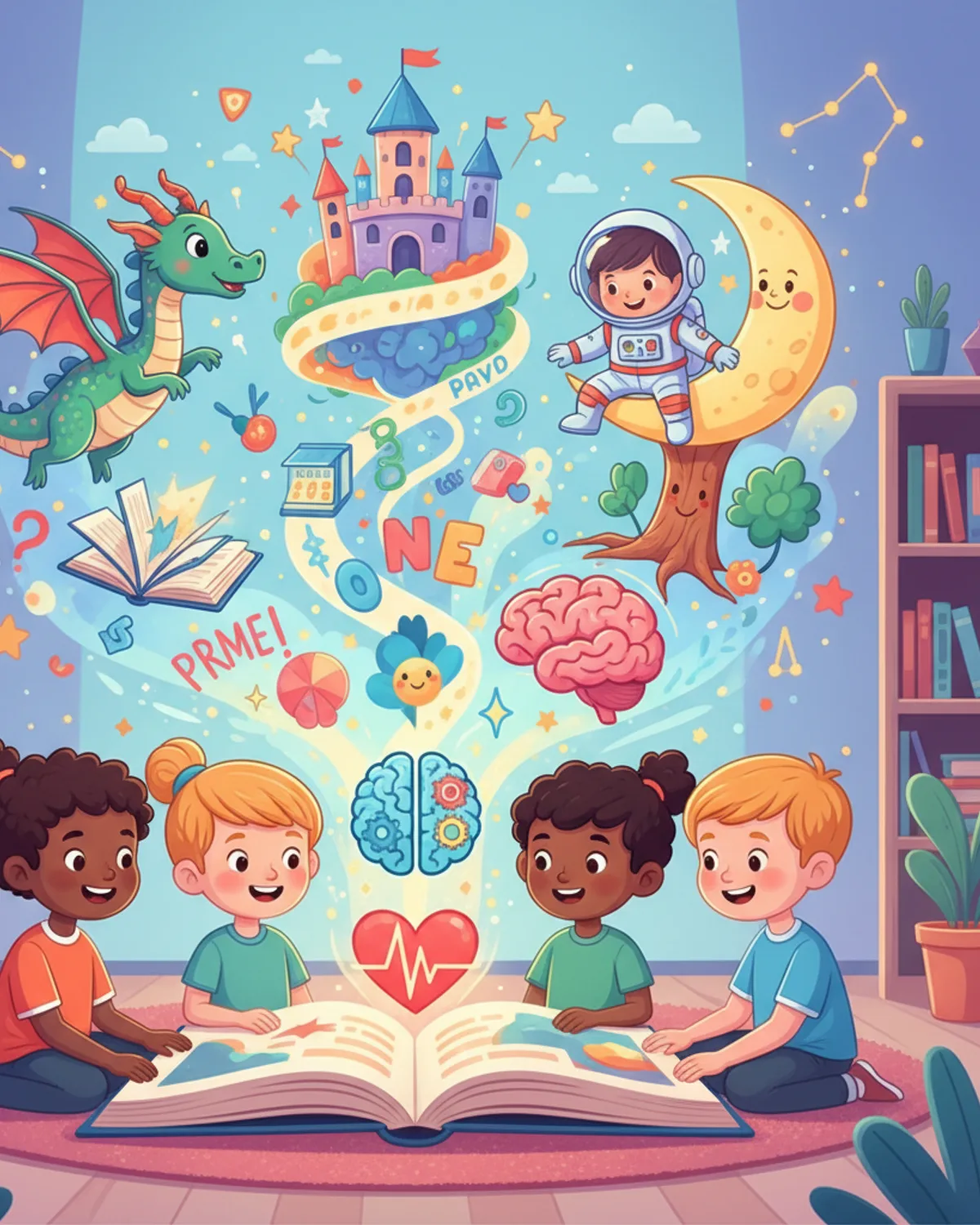
A homeschool parent told us her son would write two lines max in a notebook.
Then she asked him to describe a generated image of his own character standing outside a stormy library. He wrote nine lines without prompting.
Nothing changed about his spelling level overnight. What changed was the writing entry point.
That pattern shows up repeatedly: illustrations don’t just make stories look nice—they change how children start, continue, and remember stories.
The real problem: many kids stall before writing quality can even develop
Adults often focus on improving sentence sophistication. But the first hurdle for many children is simply getting past the blank page.
What actually happens without visual support:
- kids overthink the first sentence,
- hesitate on scene details,
- and stop before narrative momentum begins.
Illustrations reduce startup friction by providing concrete context.
Insight #1: pictures function as cognitive scaffolding, not decoration
In practice, children use illustrations as reference points:
- “He looks worried here, so maybe he lost something.”
- “There’s a door behind her—maybe that’s where she goes next.”
This helps kids generate sequence and cause-effect without inventing every detail from scratch.
Insight #2: illustrations improve emotional specificity
When a child can point to posture, expression, and setting, emotional writing becomes more precise.
Weak line: “She was sad.”
Stronger line after image prompt: “She kept smiling, but her hands were squeezed into her sleeves while everyone else teamed up.”
The second line is more readable, more empathetic, and more useful for discussion.
Insight #3: image continuity helps story continuity
When recurring character details remain stable (same scarf, same backpack, same room), children produce fewer plot breaks.
What we noticed: continuity cues in visuals help children remember unresolved story elements and bring them back later.
[See also: how AI illustration works step by step]
What illustrations change for reading, not just writing
Better comprehension checks
Instead of asking “What happened?”, adults can ask:
- “What detail in this picture shows the character changed?”
- “What object here might matter later?”
These questions produce deeper comprehension responses than recall-only prompts.
Stronger inferencing
Children infer motivations from visual cues, then verify with text.
Example classroom prompt: “Look at page 4 only. What do you predict happens on page 5, and what in the image makes you think that?”
Improved re-read value
Kids revisit illustrated stories more often, especially when they helped create the visuals. Re-reading compounds vocabulary and structure familiarity.
[See also: classroom routines that use story images without losing writing time]
Concrete examples: where illustrations help most
Scenario A: reluctant writer at home
Before image: “Once there was a dog. The end.”
After image cue: “Once there was a dog waiting by the bus stop with one red boot. He looked at every bus because his girl moved away last week.”
Why improvement happened: image introduced concrete setting + emotional contradiction.
Scenario B: mixed-level classroom
Teacher uses one shared image and asks all students to write one sentence at their level:
- Emerging writer: “The boy is hiding.”
- Developing writer: “The boy hides behind the curtain because he hears footsteps.”
- Advanced writer: “He stays behind the curtain long enough for dust to settle on his sleeve, then decides not to run.”
One visual can differentiate instruction naturally.
Scenario C: SEL discussion without forced disclosure
Prompt: “Write a scene where the character pretends they’re okay. What visual clue tells us they aren’t?”
Students engage emotional reasoning through character analysis rather than personal confession.
Practical ways to use illustrations immediately
For parents
- Ask for one “what do you notice?” sentence before reading.
- Ask for one “what changed?” sentence after reading.
- Revisit the same image next day and add one new detail to the story.
For teachers
- Use a one-image quickwrite to start class.
- Limit image generation to one pass + one revision.
- Grade process moves (specificity, sequence, revision) before polish.
For homeschoolers
- Pair each weekly topic with one illustrated micro-story.
- Use image-based narration for science/history recall.
- Archive monthly storybooks to track writing growth.
What doesn’t work
- Overly busy visuals for emerging readers
- Treating images as final products instead of writing tools
- Regenerating endlessly before drafting text
- Ignoring visual continuity across pages
In practice, image-first only works when it quickly transitions to language work.
Soft product integration: using SparkyTales intentionally
SparkyTales is strongest when used as a writing amplifier:
- Child drafts a short scene.
- Generate an illustration for that scene.
- Child revises text to add one sensory detail and one emotional cue.
- Repeat for next page.
This loop keeps ownership with the child while reducing blank-page anxiety.
[See also: practical writing moves that keep children engaged]
Illustrations matter because they make story thinking visible. When kids can see the moment, they can usually write the moment. And once they can write one moment clearly, they can build a full story with confidence.
Ready to write your own?
Create your first illustrated storybook with Sparkytales.
Start writing free