From ‘One Random Bedtime Idea’ to a Re-Readable Storybook: The Exact Process We Use
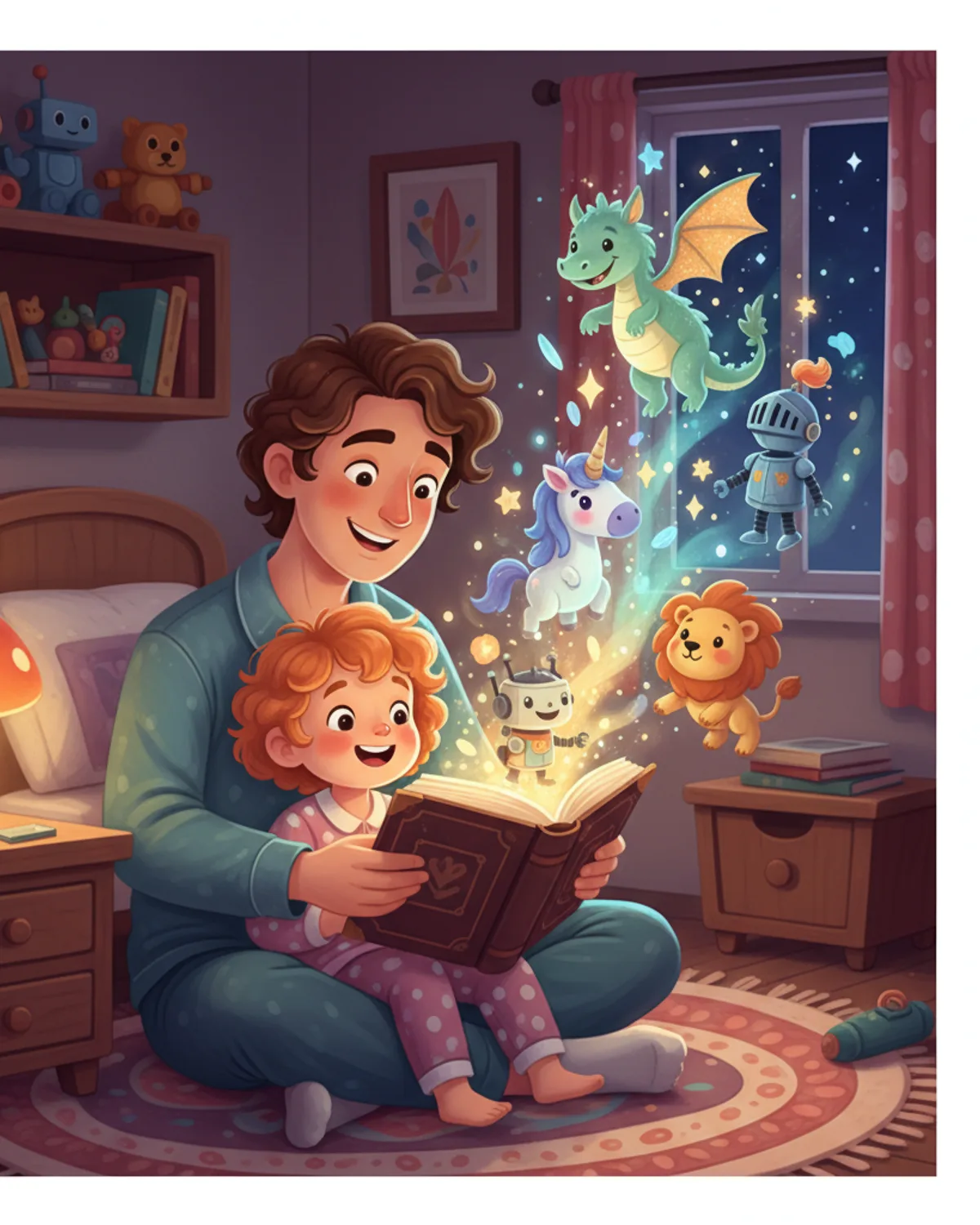
At 9:02 p.m., your child says, “What if a sleepy dinosaur couldn’t find her blanket?”
By 9:04 p.m., teeth still need brushing, someone is thirsty again, and the idea is gone.
That is what actually happens in most homes. Parents don’t struggle with imagination—they struggle with capture and follow-through.
The good news: you don’t need an hour, a perfect outline, or writing expertise. You need a tiny repeatable system.
The real bedtime problem: great ideas evaporate under time pressure
When adults try to “make a full story” in one sitting, bedtime gets longer and tension rises.
Common failure pattern:
- Child gives a great spark
- Adult asks too many development questions
- Momentum drops
- Story becomes negotiation (“one more page…”) instead of winding down
In practice, the best bedtime stories are built in layers across multiple nights.
Insight #1: capture first, expand later
We noticed parents often lose ideas because they try to structure immediately.
A better sequence:
- Capture one-line idea.
- Repeat it back to confirm.
- Add only one “what happened next?”
- Stop.
That tiny capture creates continuity for tomorrow without overstimulating bedtime.
Insight #2: bedtime stories work better when conflict is “small and solvable”
Kids do not need dramatic stakes at night. They need emotional closure.
What works best:
- lost object, found friend
- small mistake, kind repair
- moment of worry, gentle reassurance
What often backfires:
- cliffhangers near lights-out
- scary antagonists introduced too late
- too many scene changes
Insight #3: illustrations reduce “what happens next?” pressure
A blank page can freeze both kids and adults. A scene image gives concrete anchors.
What actually happens when you add visuals:
- Child points to details and adds language naturally
- Parent asks fewer abstract questions
- Story continuity improves (“same pajamas, same room, next scene”)
[See also: why illustrated stories help kids continue writing]
A practical 3-night workflow that parents can start tonight
Night 1: Capture the seed (3–5 minutes)
Use this exact script:
- “Tell me your idea in one sentence.”
- “What does your character want right now?”
- “What tiny problem shows up?”
Example:
Child: “A dinosaur can’t find her blanket.”
Parent capture note: “Dina the dinosaur wants to sleep but her star blanket is missing.”
Stop there. Read or tell a short improvised version and end bedtime.
Night 2: Build beginning + middle (7–10 minutes)
Prompt:
- “Where does Dina look first?”
- “Who helps, and how?”
Sample output snippet: “Dina checked under the moon chair, then inside the toy basket. Her brother said, ‘Let’s look where you read stories.’”
If using illustration, generate one scene after drafting those lines. Ask: “What detail should we add to make it feel like your room?”
Night 3: Add ending + title (7 minutes)
Prompt:
- “What helps Dina finally feel calm?”
- “What is a good title for this story?”
Sample ending: “The blanket was in the reading tent. Dina wrapped up, listened to rain sounds, and whispered, ‘Tomorrow I’ll make a blanket map.’”
Now the story is complete and revisit-ready.
[See also: the science behind why bedtime reading sticks]
Prompt templates that consistently work at bedtime
Use one per night, not all at once.
- “A character who is almost ready for sleep, but one small thing is missing.”
- “A quiet helper appears when the room feels too dark/too noisy/too new.”
- “A bedtime mistake turns into a cozy discovery.”
- “A character learns a tiny nighttime routine that makes tomorrow easier.”
Why these work: they move toward calm, not escalation.
Where parents accidentally derail bedtime stories
- Asking five follow-up questions in a row
- Correcting grammar during idea capture
- Adding moral lessons too early
- Treating every story as a major project
In practice, bedtime storytelling works best when it feels like connection, not curriculum.
Quick quality checklist (before you finalize the story)
Ask:
- Is the main feeling clear by page 2?
- Is the problem small enough for bedtime?
- Is the ending calming, not energizing?
- Could this be read in under 8 minutes?
If yes, you’re done.
Soft product integration: using SparkyTales without turning bedtime into screen time overload
SparkyTales works well for bedtime when used in “short burst” mode:
- Capture idea verbally.
- Generate one supportive illustration.
- Write 2–4 short pages.
- Close device and read aloud from the finished version.
That sequence keeps technology as a helper, not the center of the ritual.
[See also: practical tips for writing children’s stories with less stress]
The goal is not to produce a masterpiece every night. The goal is to preserve your child’s ideas in a way that feels safe, repeatable, and genuinely cozy.
One good tiny story told three times is often more valuable than one “perfect” story that never gets read again.
Ready to write your own?
Create your first illustrated storybook with Sparkytales.
Start writing free