We Tested Story Prompts with Quiet Kids for 30 Days — Here’s What Actually Helped Them Open Up
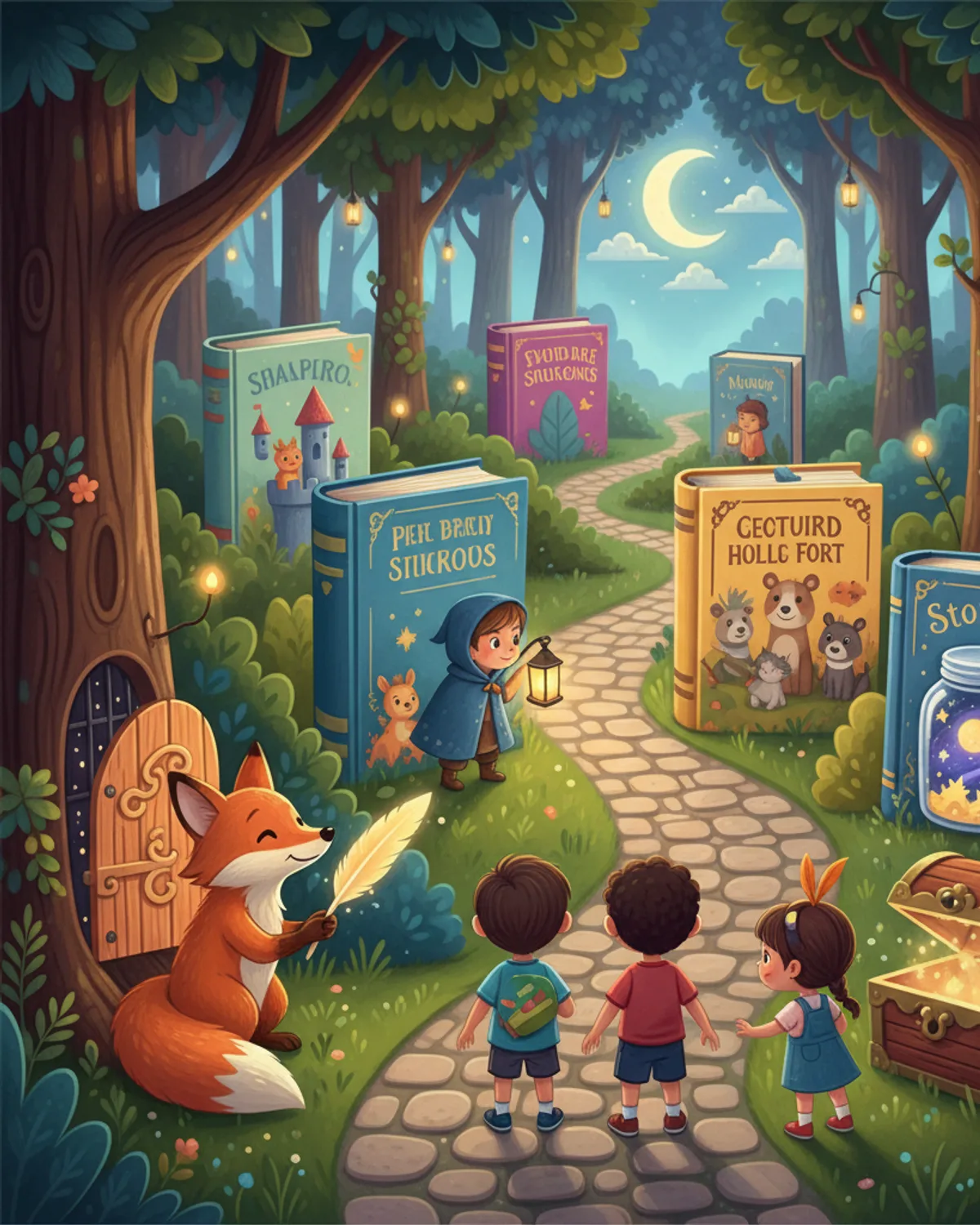
At 8:17 p.m., one mom in our community tried the same bedtime question she’d asked all week: “How was school?”
Her second grader gave the usual one-word answer: “Fine.”
Then she changed one thing.
Instead of asking about him, she asked: “Can you make up a story about a fox who had the weirdest recess ever?”
He started with one sentence. Then three. Then he added, “The fox pretended he didn’t care, but he did care, because nobody picked him for the game.”
That is the pattern we keep seeing with quiet kids: direct questions shut the door; story opens it.
Not always. Not instantly. But often enough that it’s worth changing your approach tonight.
This post is not a “storytelling is important” article. It’s a field guide based on what we noticed in practice while parents, teachers, and homeschoolers used prompts with reserved kids ages 6–11: where children hesitate, which prompt shapes work, what phrasing backfires, and why illustration changes the writing behavior more than most adults expect.
The real problem isn’t shyness — it’s performance pressure
Most quiet kids aren’t “unable to express themselves.” They’re overloaded by the social risk of being wrong, exposed, or too visible.
What actually happens in many homes and classrooms:
- We ask for personal sharing too early (“Tell the class what upset you”).
- The child predicts judgment.
- Their language compresses to minimal output (“I don’t know,” “nothing,” shrug).
- Adults interpret this as unwillingness.
In practice, kids who say very little in direct conversation often generate rich narrative detail when the emotional content is assigned to a character. That distance matters. It lowers the stakes.
A second-grade teacher in our testing group put it simply: “If I ask for feelings, I get silence. If I ask for a penguin with a problem, I get a full page.”
That’s not avoidance. That’s safer access.
A non-obvious insight: most kids stop after 1–2 sentences unless there’s a visual anchor
One of the clearest patterns we noticed: many kids begin willingly, then stall.
A typical start looked like this:
“Once there was a girl named Mia. She was shy.”
And then… nothing.
When we added an illustration step (“What does Mia’s classroom look like?” or a generated image they could react to), output length increased because children had concrete details to point at:
“Mia sat near the fish tank because it was noisy and she liked that. Her pencil broke when everyone was already writing and she didn’t want to ask for a new one.”
The illustration didn’t just make it fun. It reduced blank-page uncertainty. Kids no longer had to invent everything from scratch; they could describe what they saw, then project feelings into that scene.
Original insight #1: For many shy children, illustrations function as “permission to continue,” not just decoration.
[See also: why illustrated stories can reduce writing resistance]
Another insight: prompt wording changes emotional honesty more than topic choice
Adults usually focus on the theme (“friendship,” “confidence,” “school”). In our sessions, wording mattered more.
Compare:
- “Write about a time you felt left out.” → often shutdown.
- “Tell a story about a character who almost joined a game but stopped at the last second.” → specific, safer, and surprisingly revealing.
The second prompt gives the child a precise moment plus emotional distance. They don’t need to confess; they can narrate.
Original insight #2: The best prompts for quiet kids are built around a micro-moment (“right before…”, “almost…”, “when everyone looked at…”) rather than a broad theme.
Why some prompts fail even when they sound gentle
We also saw common misses:
- Too abstract: “Write about bravery.”
- Too evaluative: “Write how to be confident.”
- Too open-ended: “Write any story you want.”
These sound flexible, but they demand planning, structure, and emotional clarity all at once. That’s a heavy lift, especially for hesitant writers.
What worked better was a narrow doorway with obvious next steps.
Example scaffold we used repeatedly:
- Pick a character.
- Give them one small problem.
- Place them in one specific location.
- Ask what they did in the first 10 seconds.
That “first 10 seconds” question was especially effective because it prevented perfection loops.
Original insight #3: Quiet kids often freeze at “the whole story” task, but move quickly when asked for the next tiny action.
Prompt examples and real-style outputs
Below are prompt structures that consistently produced richer responses in classrooms, after-school sessions, and bedtime routines.
Prompt 1: “A character who almost speaks, then doesn’t”
Prompt: “Create a character who wants to say something important in class. They raise their hand halfway, then put it down. What were they going to say?”
- Kids often reveal social fears here (wrong answer, laughter, attention).
- Responses become more specific if you ask: “What did they feel in their hands/stomach/throat?”
Sample output snippet: “Eli knew the answer about planets, but his face got hot. He looked at the poster instead of the teacher. He told himself, ‘Say it next question,’ but the lesson moved on.”
Prompt 2: “The hidden helper”
Prompt: “Tell a story about a character who has one secret helper at school (person, animal, or imaginary object). How does that helper make hard moments easier?”
- Kids externalize coping tools without being asked to “share coping tools.”
- Great for identifying what support already works (sitting near a friend, fidget item, teacher signal).
Sample output snippet: “Nora had a tiny paper crane in her pocket. When reading time came, she touched its wing and counted to four. Then her voice came out less shaky.”
Prompt 3: “The scene before courage”
Prompt: “Write only the part before the brave moment. Where is the character? What do they hear? What almost makes them quit?”
- Kids write more honestly about fear than about success.
- If you skip straight to triumph, many write generic endings.
Sample output snippet: “Dev stood outside the music room and heard everyone tuning. He almost walked to the bathroom instead, but then he remembered his friend saved him a chair.”
Prompt 4: “Misread face”
Prompt: “A character thinks someone is mad at them, but they’re wrong. What clues did they misread?”
- Useful for children who interpret neutral social signals as rejection.
- Helps build perspective-taking through narrative, not lecture.
Sample output snippet: “Rae thought the coach frowned because of her. But the coach was squinting at the sun and looking for a missing whistle.”
Prompt 5: “New kid, one good minute”
Prompt: “Your character is new at school. Most of the day is hard. Write one minute that turns out better than expected.”
- Prevents forced positivity while still training attention toward workable moments.
- Good for children transitioning schools or groups.
Sample output snippet: “At lunch, Mateo dropped his spoon. A kid from table three picked it up and said, ‘You can sit here if you want.’ It wasn’t magic. It was enough.”
[See also: classroom story routines that work in mixed-confidence groups]
What parents and teachers can do immediately (tonight or tomorrow)
If you want better results fast, use this simple workflow.
Step 1: Start with a low-pressure setup
Say: “Let’s invent, not report.”
That single sentence tells kids they are not being graded or cross-examined.
Step 2: Give one constrained prompt, not five choices
Choice overload leads to stalling. Offer one prompt and begin together.
Good opener: “I’ll do the first line, you do the second.”
Step 3: Ask process questions, not interpretation questions
- “What happened right before that?”
- “What did they do with their hands?”
- “Who noticed?”
- “Is this about you?”
- “Why are you like this character?”
When adults decode too early, kids retreat.
Step 4: Add an image at the stall point
When the child says “I’m done,” don’t force another paragraph. Add a visual cue:
- Draw a quick stick-scene together, or
- Use an illustration tool to generate the scene and ask, “What detail is missing?”
That “missing detail” question restarts writing without pressure.
Step 5: End before fatigue
Counterintuitive but true: stopping early increases return rate.
If the child writes four strong lines, celebrate and stop. A child who leaves feeling successful is far more likely to write again tomorrow.
[See also: bedtime storytelling habits that improve next-day writing]
Where grown-ups accidentally make things worse
Even with good intentions, a few habits reliably reduce output:
- Over-praising too soon: “That’s amazing!” after one sentence can feel like a spotlight.
- Fixing mechanics in draft one: correction mode kills emotional flow.
- Requesting moral lessons: “What did we learn?” often turns authentic writing into performance writing.
In practice, the best response is usually neutral and curious:
“That line felt real. Want to add what happened right after?”
Calm curiosity keeps the door open.
Soft integration: using illustrated story tools without turning it into screen overload
If you use a tool like SparkyTales to co-create illustrated stories, the win is not “more AI.” The win is structure + visual momentum.
A practical way families and teachers are using it:
- Child chooses one prompt.
- Adult helps generate a first illustration.
- Child describes what the character is feeling in that image.
- Together they add 2–4 short pages, not a full book.
- They revisit and expand another day.
That pacing matters. Trying to produce a long, polished story in one sitting can recreate the same pressure quiet kids already feel in school.
Short, repeatable sessions work better than occasional marathon sessions.
For classrooms, we noticed this format helps too:
- 8 minutes prompt + scene generation
- 10 minutes writing
- 5 minutes optional partner share (read one line, not whole story)
Kids who never volunteer for full read-aloud often agree to share a single line if the expectation is tiny and predictable.
The bottom line
Shy kids usually do have stories ready. They just don’t share them well under direct social pressure.
What actually works is a safer pathway:
- character distance,
- micro-moment prompts,
- visual anchors at stall points,
- and adults who stay curious instead of interpretive.
If you try one thing today, try this exact sentence:
“Tell me about a character who almost said something important, but stopped. What happened in that moment?”
Then listen longer than feels comfortable.
The pause is often where the real story starts.
Ready to write your own?
Create your first illustrated storybook with Sparkytales.
Start writing free